

IEHWS

International Employee Happiness & Wellbeing Standard

The definitive framework for creating workplaces where people thrive. Global best practices in employee experience, happiness and wellbeing have been researched, reviewed and codified into a comprehensive, measurable standard.

8

SECTIONS

6

VECTOR MODEL

40+

COUNTRIES

What is IEHWS?

The International Employee Happiness & Wellbeing Standard (IEHWS) establishes the requirements for creating, sustaining and continuously improving employee happiness and wellbeing across the whole organisation. It bridges the gap between organisational intent and lived employee experience, ensuring that workplaces are healthy, supportive, fair and genuinely fulfilling.

Born from extensive research into employee wellbeing and workplace best practice across industries and geographies, IEHWS provides a structured, measurable framework that any organisation can implement. The standard encompasses the complete employee experience, from joining and onboarding through to growth, recognition and long-term engagement, ensuring consistency across every stage of the employment journey.

By adopting IEHWS, organisations gain a competitive advantage through improved engagement, reduced absence and attrition, and a clear pathway to a healthier, more resilient and higher-performing workforce.

Framework & Approach

Built on global research across 40+ countries, IEHWS combines best practices from leading organisations with scientifically-proven wellbeing principles. The standard is structured around eight core sections, supported by the Vector 6 happiness model and twelve experience pillars.

This comprehensive approach ensures organisations can assess their current state, implement meaningful improvements, and sustain a culture where employees genuinely thrive.

The Vector 6 Employee Happiness Model

Six interconnected, interdependent dimensions that define and drive genuine employee happiness, well-being and engagement. The architecture of IEHWS:01.

Developed by ICXI with HR specialists, psychologists, wellbeing academics, BSI and ICXI-certified organisations · Certified by BSI
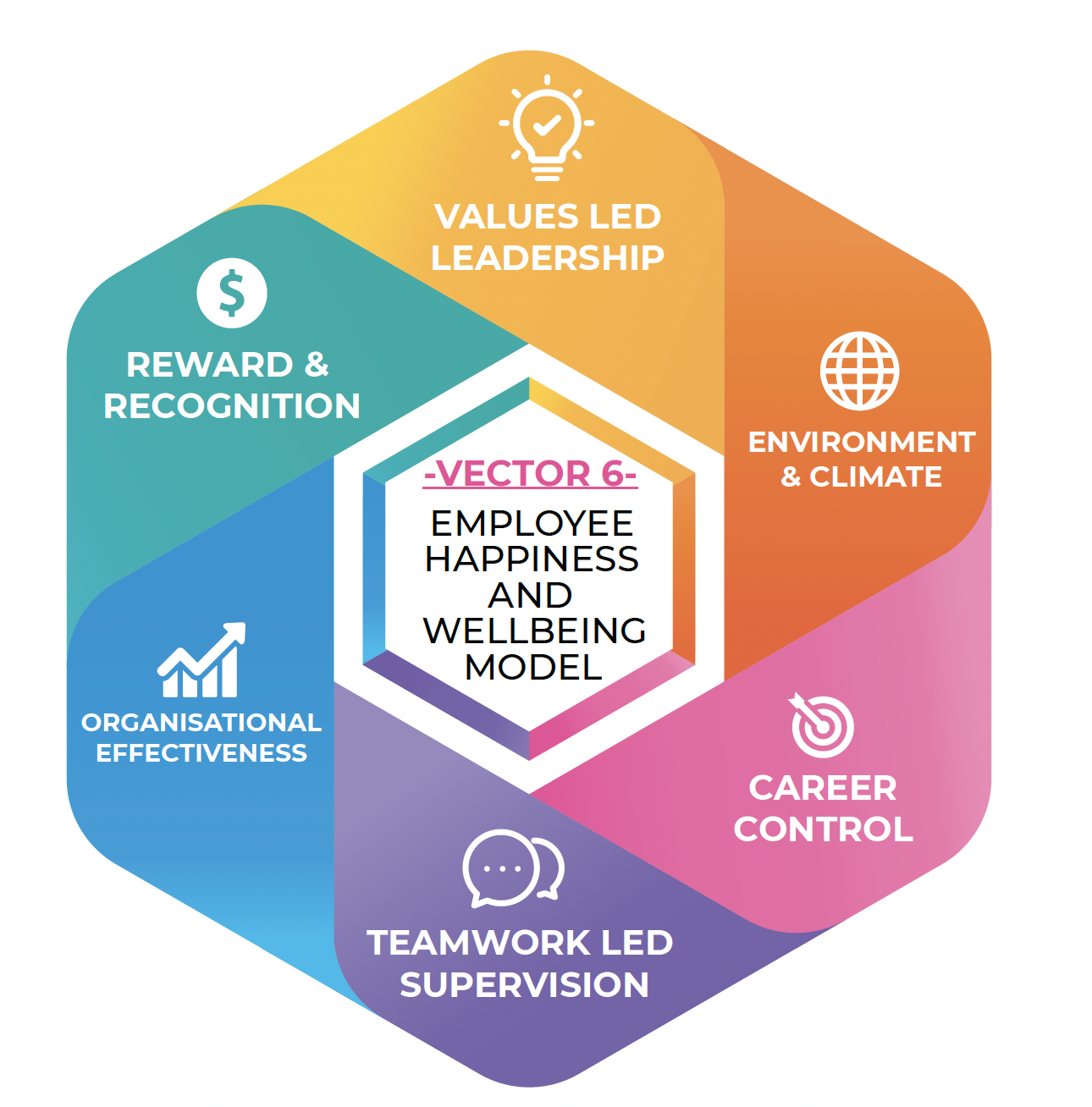
Values-Led Leadership

01

The values leaders share, prioritise and live by — the foundation of organisational culture.

The sum and priority of values shared by an organisation’s leaders is the foundation of its culture. Employees increasingly choose to work for — and remain with — organisations whose ethical, social and environmental conduct they identify with. Values-led leadership is essential to create and sustain a positive employee experience.

Environment and Climate

02

A safe, healthy operational environment — and an emotional climate that engages people.

Beyond the physical safety of the workplace, the emotional climate drives motivation, engagement and responsiveness. With the rise of hybrid and remote working, the challenge has extended to managing a positive, safe and engaging environment for a widely distributed workforce — addressing emotional and physical well-being together.

Career Control

03

The degree to which employees feel real influence over their personal development.

Whether employees aspire vertically, develop deep horizontal expertise, or value stability in role, the common thread is the freedom to pursue their own ambition without being suppressed or trapped. Career control protects against bias on grounds of race, gender, religion, culture or any other dimension of diversity.

Teamwork-Led Supervision

04

How employees experience the way they are managed and the way teams function together.

Teamwork is both local — within the immediate team — and organisational, where the whole enterprise functions as one. Most employees leave organisations because of their relationship with a supervisor or manager: interpersonal behaviour, communication, respect and recognition. Strong teamwork-led supervision keeps people engaged at every level.

Organisational Effectiveness

05

How employees feel about the organisation’s competence and its fulfilment of customer promises.

Employees are aware when the organisation is not operating effectively or is failing its customers. Loss of clear purpose leads to frustration, disengagement and departure — at every level, from frontline to leadership. Effectiveness shapes the sense that the work matters and is being well done.

Reward and Recognition

06

How employees experience compensation, recognition and the reinforcement of contribution.

Financial compensation must be competitive to attract and retain talent — but recognition extends far beyond money. Formal and informal recognition, and positive reinforcement of contribution, are powerful motivational tools that drive engagement, productivity and loyalty across every level of the organisation.

An Interconnected, Interdependent Model

The six dimensions of the Vector 6 model are independent — but inextricably interdependent. Like the 5 P’s marketing model, the Vector 6 model requires simultaneous, pan-model leadership attention. Excellence in one element cannot compensate for weakness in another. The IEHWS:01 Standard sets out how organisations assess, improve and certify their performance across the full model.

The Vector 6 model is the architectural foundation of the IEHWS:01 Standard. The Standard further sets out assessment criteria, performance measurement and certification pathway — independently certified by BSI.

The 8 Sections of the Standard

Comprehensive framework covering every aspect of employee experience

Values Led Leadership

Strategic intent, top-management commitment and the Employee Happiness & Wellbeing Pledge — with empowerment, communication and brand values embedded from the board down.

Environmental Climate

The physical and cultural working environment: equal opportunities, freedom of expression, teamwork and team spirit, and genuine work-life balance.

Career Control

The employee employment journey, performance assessment and personal development that give people real ownership of their growth.

Teamwork Led Supervision

Effective teamwork, supportive supervision and the protection of employee rights across every team.

Organisational Effectiveness

Employee engagement, corporate citizenship and brand image that connect people to purpose and performance.

Reward & Recognition

Fair reward and recognition, and the role of leaders, managers and supervisors in celebrating and sustaining great performance.

Measurement of Performance

Employee happiness measurement, leadership measurement, brand perception analysis, benchmarking, employee confidence and exit interviews.

Performance Measurement Results

Demonstrable outcomes — employee happiness results tracked over time, with top-management review evidencing real and sustained improvement.

Your Certification Pathway

Five essential steps to achieving IEHWS certification

01

Assess

Evaluate your EX maturity using the Experience Excellence Index

02

Implement

Apply the IEHWS 2023 framework and Vector 6 Model

03

Measure

Track happiness and wellbeing through structured criteria

04

Certify

Achieve formal certification to IEHWS 2023

05

Sustain

Build continuous improvement into your culture

Implement the Standard

Begin your journey to cerfication below, select either the Standard or our Online Assessment depending on where you are in your customer experience journey.

Any questions please contact us here