

IPEXS

International Patient Experience Standard

The world’s first international standard for patient experience in healthcare. Global best practices in clinical excellence, compassion and patient partnership have been researched, reviewed and codified into a definitive framework for healthcare experience excellence.

PX-DNA

FRAMEWORK

12

PX Pillars

40+

COUNTRIES

What is IPEXS?

The International Patient Experience Standard (IPEXS) is the world’s first comprehensive framework specifically designed for healthcare organisations seeking to deliver exceptional patient experiences. It recognises that clinical excellence alone is not enough — patients deserve care that is compassionate, coordinated, transparent, safe and centred around their needs.

IPEXS bridges the gap between clinical governance and experience management, providing healthcare organisations with a structured, measurable framework that encompasses the entire patient journey — from first contact through treatment to aftercare and beyond.

The 12 Pillars of Patient Experience Excellence

Twelve interconnected pillars that define what excellent patient experience looks like — across vision, dignity, voice, evidence, culture, equity, communication, innovation, safety, learning, journey continuity and access. The architecture of IPEXS:01.

Developed by ICXI with clinical leaders, patient advocates, healthcare quality experts and BSI · Aligned with international patient safety and quality regimes

Vision & Integrity

01

Clear, accountable PX governance — owned at executive, clinical and operational levels.

Governance determines whether patient experience is protected or vulnerable. This pillar examines whether PX ownership is clearly defined and documented, whether leadership prioritises it visibly, and whether escalation, decision-making and performance frameworks consistently treat the patient’s experience as a board-accountable outcome rather than an aspiration.

Respect & Compassion

02

Dignity, emotional sensitivity and human connection throughout the care journey.

Compassion is a core clinical behaviour, not a discretionary attitude. This pillar evaluates whether patients consistently experience care as humane, dignified and emotionally safe across every interaction — and whether the organisation treats lapses in tone or emotional harm as opportunities to learn rather than something to defend.

Voice & Partnership

03

Patients recognised as genuine partners in decisions about their care.

The patient is the most underused expert in their own care. This pillar assesses whether patients are actively involved through shared clarity, dialogue, real options and informed consent — and whether that partnership is genuine and systematic rather than a formality or a signature on a form.

Insights & Evidence

04

Patient insight that directs decisions and resources — not just informs discussion.

Evidence that does not change practice is just storage. This pillar evaluates the breadth and quality of patient experience data — metrics, narratives, complaint themes and safety signals — and, crucially, whether that insight actually determines decisions, prioritisation and accountability, rather than simply informing conversation.

People & Culture

05

A culture set by leadership behaviour, sustaining the workforce that delivers care.

Patient experience is delivered by people within a culture — and culture is demonstrated through what leaders do, not what they say. This pillar examines whether leaders model the behaviours that set cultural standards, whether staff are capable, confident and psychologically safe, and whether the organisation invests in the workforce on which every other pillar depends.

Fairness & Belonging

06

Equal behavioural treatment for every patient, regardless of identity or circumstance.

Patient experience excellence is incompatible with inequitable care. This pillar assesses whether all patients receive fair, dignified treatment regardless of identity, background, status, language, disability or perceived difficulty — and whether the organisation actively identifies, measures and reduces disparities in access, treatment and outcome for its most vulnerable groups.

Clarity & Trust

07

Communication that lets patients understand what is happening, why, and what comes next.

Trust is built or lost in the moments of communication. This pillar evaluates whether information enables patients to follow their care journey without confusion, whether communication stays honest during difficult moments, and whether the organisation reliably does what it tells patients it will do.

Innovation & Inclusion

08

Innovation that solves real, evidenced problems — and includes everyone it affects.

Innovation is meaningful only when it solves real problems and includes the people it impacts. This pillar examines whether new approaches — including digital and AI-enabled care — address needs identified by patients, staff and evidence rather than enthusiasm-driven ideas, and whether they are introduced without widening access gaps or compromising the dignity of patients least able to navigate change.

Space & Safety

09

Physical, emotional, procedural and environmental safety that protects dignity.

The environment of care is part of the experience. This pillar assesses whether physical spaces support privacy, dignity and safe emotional space — not just clinical delivery — alongside accessibility, infection control, and the procedural and psychological safety of patients and staff alike.

Learning & Excellence

10

Patient experience treated as a structured learning system, not an occasional topic.

Excellence is sustained through learning, not declared through compliance. This pillar evaluates whether the organisation runs patient experience as a structured learning system — formal review cycles, clear ownership and tracked actions — integrating learning from incidents and near-misses, openness to external benchmarking, and a visible discipline of continuous improvement.

Connection & Journey

11

A patient journey connected end-to-end — across services, transitions and time.

Patients experience a journey, not a series of departments. This pillar examines whether care is connected end-to-end — across primary, secondary and community settings, across digital and physical channels, and across the handoffs and transitions where experience is most often lost — with the continuity and emotional joining-up that removes experience gaps.

Access & Efficiency

12

Predictable, equitable access with clear routes that respect patients’ time and energy.

Access is a precondition of every other dimension of experience. This pillar assesses whether access is predictable and reachable, with clear routes to start, continue and complete each stage of care — examining waiting times, pathway efficiency, equity across populations and geographies, and the administrative friction borne by patients and carers that the organisation should continuously design out.

Twelve Interconnected Pillars · One Patient Experience

The 12 Pillars of IPEXS:01 are independent disciplines but inextricably interdependent. A failure in any one — fairness, safety, communication, governance — compromises the integrity of the whole. The Standard applies the QERE methodology (Question · Explanation · Reasoning · Evidence) to assess organisational maturity across all twelve, with independent certification by BSI.

IPEXS:01 is the International Patient Experience Standard, published by ICXI and certified by BSI. The 12 Pillars are assessed using ICXI’s QERE methodology and aligned with the ICXI maturity progression — supporting healthcare organisations to evidence and improve patient experience as a strategic, system-level capability.
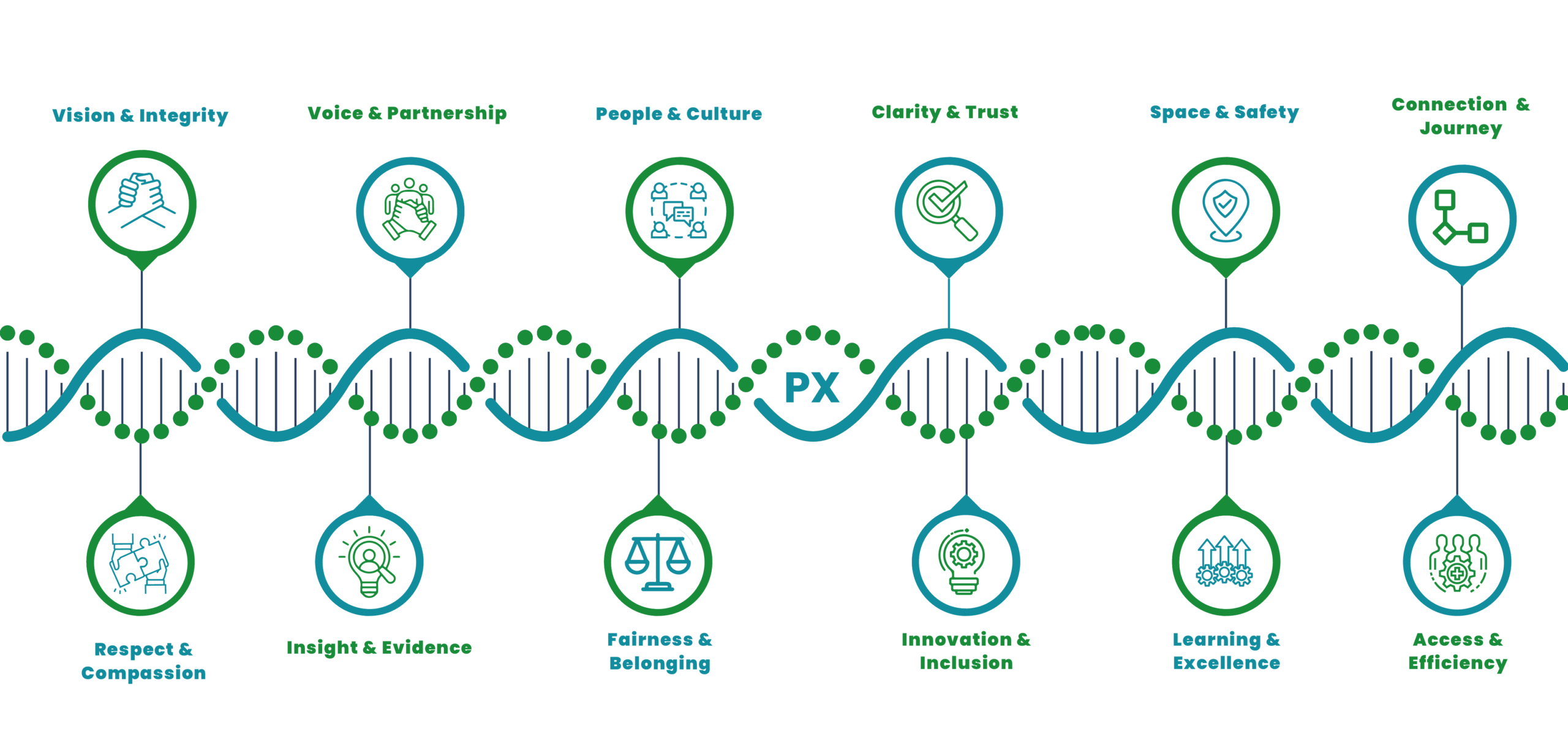
The PX-DNA Framework

The Fundamental Building Blocks of Exceptional Patient Experience

The PX-DNA Framework identifies the fundamental building blocks — the “DNA” — of exceptional patient experience, structured into 12 interconnected sections that together define what healthcare excellence looks like from the patient’s perspective.

Certification Pathway

Five steps to achieving IPEXS certification

01

Assess

Evaluate your PX maturity using the Experience Excellence Index

02

Implement

Apply the IPEXS PX-DNA Framework across your organisation

03

Measure

Track progress through structured patient experience criteria

04

Certify

Achieve formal certification to IPEXS

05

Transform

Build a culture of continuous patient experience improvement

Implement the Standard

Begin your journey to cerfication below, select either the Standard or our Online Assessment depending on where you are in your customer experience journey.

Any questions please contact us here