

The 12 CX Pillars

Framework · Maturity · The structure behind every ICXI assessment

12

Pillars

5

MATURITY LEVELS

120

CRITERIA
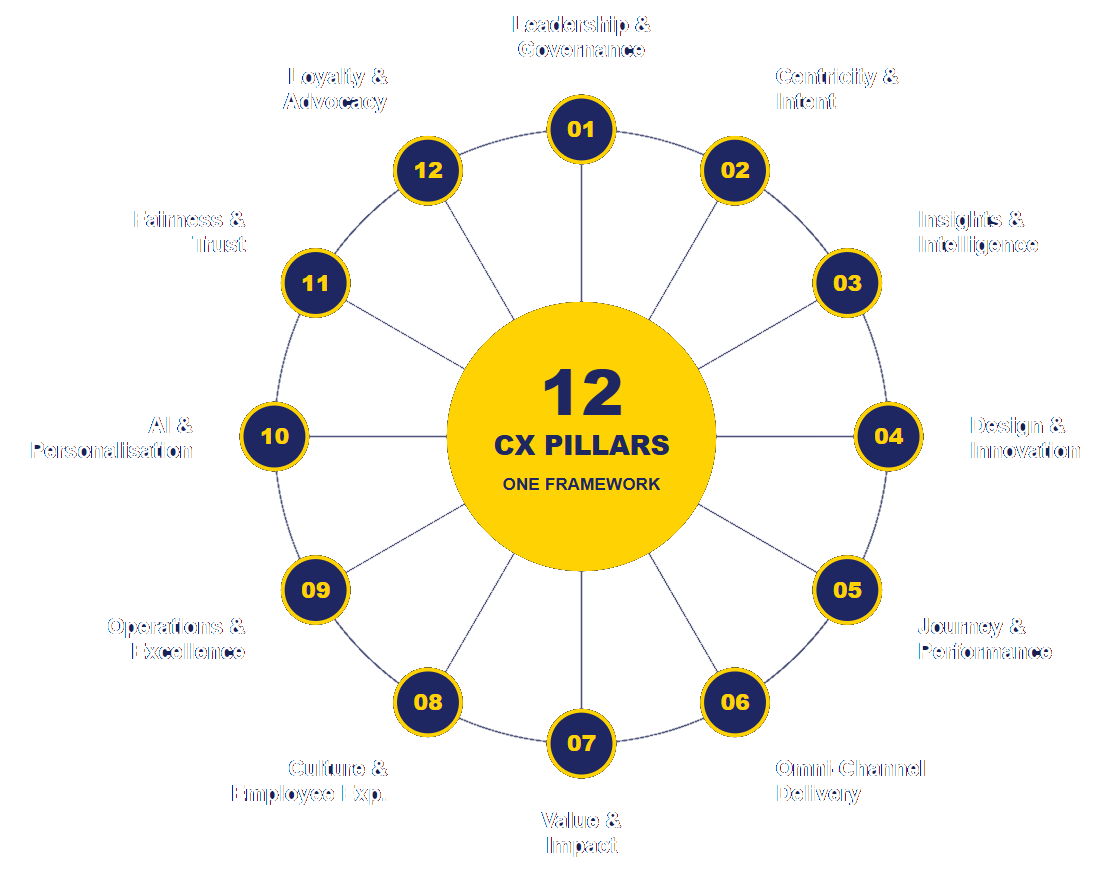
What are the 12 pillars of customer experience?

The 12 CX Pillars are ICXI’s customer experience framework: twelve dimensions of CX capability, each measured against five levels of maturity. One structure runs through every ICXI assessment, standard and award, from first self-assessment to formal certification and global recognition. Each pillar covers one dimension, together spanning the full arc from board-level ownership, through insight and design, to delivery, trust and long-term impact.

01

CX Leadership & Governance

Executive ownership, board-level oversight, decision rights, and the systems that keep CX protected under commercial pressure.

02

Customer Centricity & Intent

Whether customer centricity is a core operating principle, visible in decisions, policies, and behaviour, rather than a slogan.

03

Customer Insights & Intelligence

How systematically insight is captured, interpreted, and converted into decisions across the full customer lifecycle.

04

Experience Design & Innovation

The capability to design, prototype, and evolve journeys and services using customer evidence, not internal preference.

05

Journey Management & Performance

End-to-end ownership and measurement of journeys, including cross-functional accountability for outcomes.

06

Omni-Channel Experience & Delivery

Consistency, continuity, and effort across every channel customers choose to use: digital, assisted, and physical.

07

CX Value, Economics & Impact

The ability to quantify CX contribution to revenue, retention, cost-to-serve, and risk in language the board accepts.

08

Culture & Employee Experience

The alignment of employee experience, leadership behaviour, and recognition with the customer outcomes you claim to value.

09

Experience Operations & Excellence

Operational disciplines, quality, continuous improvement, and recovery, that turn design intent into delivered reality.

10

AI, Automation & Personalisation

Ethical, effective use of AI, automation, and data personalisation to enhance, not degrade, the customer experience.

11

Fairness, Transparency & Digital Trust

Fair treatment, inclusive design, ethical data use, and the trust signals regulators and customers increasingly demand.

12

Loyalty, Advocacy & Long-Term Impact

The sustained outcomes, loyalty, advocacy, lifetime value, brand equity, that a mature CX capability should produce.

Twelve pillars, five levels of maturity

The framework is applied by ICXI, the international standards body for customer, digital, employee and patient experience, and used by organisations in over 40 countries. Every pillar is scored on the same five-level scale, from Emerging to Exemplary, anchored to observable evidence: documentation, interviews and journey data, never opinion alone. The result is a formal Maturity Rating, a full diagnostic and a prioritised roadmap, and, where the bar is met, ICXI certification and eligibility for the Experience Excellence Awards.


01

Emerging

Early stage of the experience excellence journey. Foundational structures, governance and consistency are not yet embedded, presenting significant opportunity to improve.

02

Developing

Experience practices are emerging and partially implemented. Intent and activity are evident, but consistency, measurement and integration remain variable.

03

Structured

Structured, proactive practices across the organisation, with clear leadership intent, growing capability and measurable progress.

04

Proactive

Experience excellence is well embedded, with strong governance and consistency, and evidence of positive impact on customers, employees and outcomes.

05

Exemplary

Best practice in experience excellence: leadership, innovation and sustained impact that make the organisation a role model within its sector or region.

What is a customer experience framework?

A customer experience framework is the structure an organisation uses to define, measure and improve its CX capability: not how customers feel this quarter, but whether the organisation has the leadership, insight, design discipline and delivery consistency that produce good experiences year after year. Survey scores measure outcomes. A framework measures the capability behind them. The 12 CX Pillars are that framework: rich enough to describe a whole organisation, simple enough to give every executive the same map.

One framework, every experience discipline

Each discipline has its own twelve pillars, tuned to its subject and measured the same way:

CX

Customer Experience Assessment, the pillars on this page

DCX

Digital Customer Experience Assessment

EX

Employee Experience Assessment

PX

Patient Experience Assessment

The framework also underpins the International Customer Experience Standard (ICXS), the certifiable standard, and is taught in the CX Professional Diploma.

Frequently asked questions

The 12 CX Pillars are ICXI’s customer experience framework: twelve dimensions of CX capability, from leadership and governance through insight, design and delivery to trust and long-term impact, against which organisations are independently assessed.

Qualified assessors evaluate 120 criteria across the twelve pillars, with every score anchored to observable evidence such as documentation, interviews and journey data. Each pillar receives a maturity rating on the five-level scale from Emerging to Exemplary.

Every ICXI assessment uses the same twelve-pillar, five-level structure, but each discipline has its own twelve pillars: customer experience, digital customer experience, employee experience and patient experience each have a set tuned to their subject.

Yes. Organisations that reach the required maturity bar in the assessment earn formal ICXI certification, and qualifying scores carry automatic eligibility for the Experience Excellence Awards.

The framework was developed by ICXI, the International Customer Experience Institute, the standards body behind the international customer, digital, employee and patient experience standards, with roots going back to the TISSE service excellence standard in 2007.